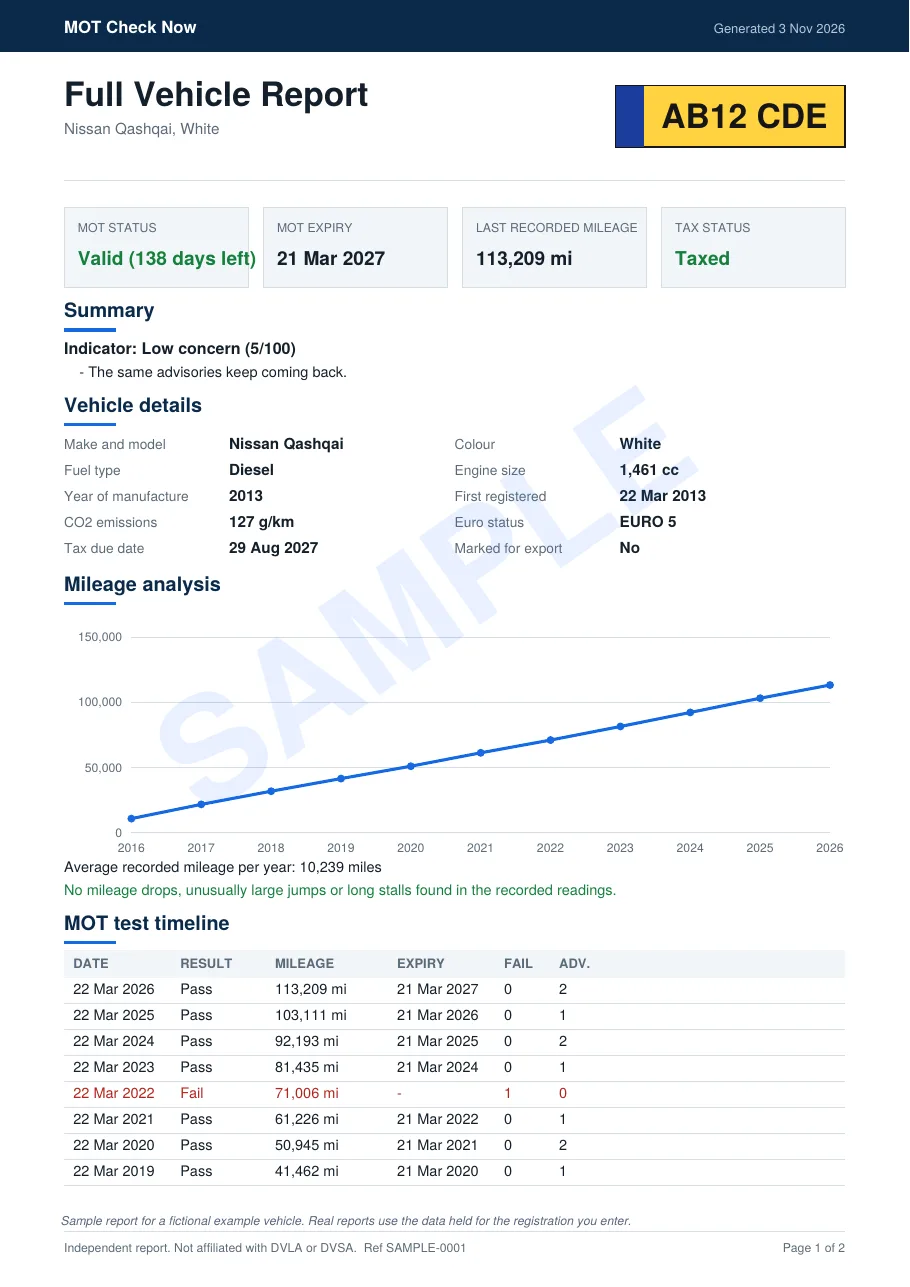
1. Vehicle details
The first page establishes which vehicle the report is about. The make, model, colour, fuel type and engine size come from the DVLA record, and the dates of manufacture and first registration come from the same source. The first thing to do with this section is the simplest: hold it against the vehicle in front of you and against the V5C log book. If the colour, the engine size or the fuel type disagree, stop and ask why. A mismatch can be an innocent paperwork error, a respray, or a sign that the plate and the vehicle do not belong together. Where the DVLA holds emissions information, such as CO2 and the Euro status, it is shown here as well. That helps you judge whether the vehicle is likely to face a daily charge in a low emission zone, although you should always confirm a charge with the official zone operator before you travel.
2. Tax and MOT summary
This section is a snapshot of the vehicle’s legal status on the day you ran the report. It shows whether the vehicle is taxed, untaxed or declared off the road under a SORN, the date tax is due, whether the MOT is valid and when it expires, and the date of the most recent recorded test. Remember that tax does not transfer with a sold vehicle, so a car that shows as taxed today will need to be taxed by the new keeper before it can be driven. The MOT status tells you how much time you have to run, which matters when you are negotiating: a car with a few days left needs a test soon, and that test could bring a repair bill. If you want to understand the tax and SORN lines in more detail, the free car tax check and SORN check explain each status.
3. Full MOT timeline
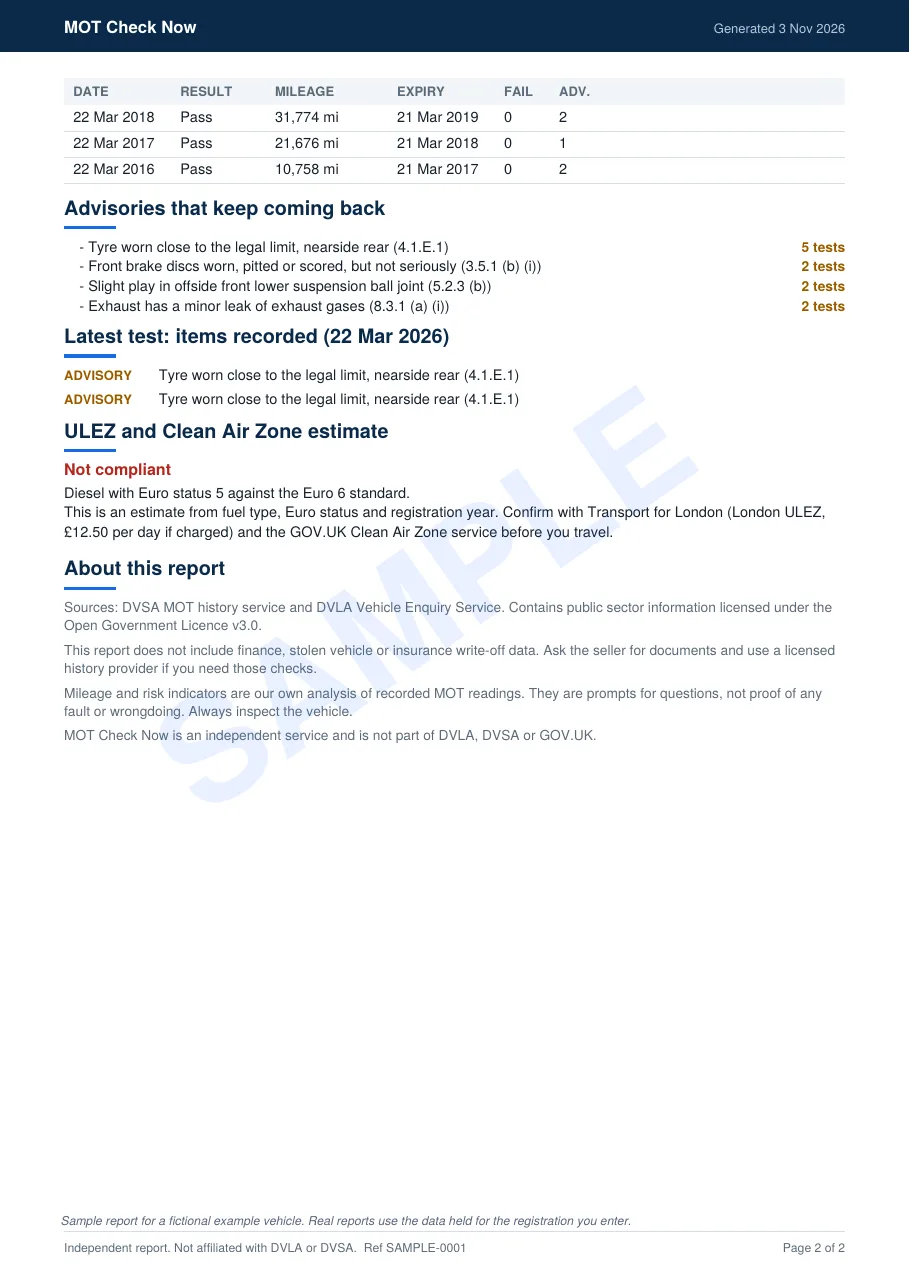
The timeline lists every recorded test for the vehicle in date order. For each one you see the completed date, the result, the expiry date the test set and the odometer reading with its unit. The point of putting it on one page is comparison. Reading a long history on a phone, row by row, makes patterns hard to see. On a document you can run your eye down the dates and notice that a car was always tested within a few days of expiry, or that it failed in the same month three years running, or that a year is missing altogether. The expiry dates are informative too. A pass that sets an expiry exactly one year after the previous one suggests the test was done in the early-test window. A pass that leaves a gap suggests the vehicle was tested after its MOT had lapsed.
4. Failure and defect detail
Under each test the report lists the defects the tester recorded, labelled with the DVSA categories. Dangerous and major defects cause a fail. Minor defects and advisories are recorded on a pass, and an item marked pass after rectification was fixed at the test centre during the test. This section is where the story of the vehicle lives. A fail result by itself says little. A fail for a worn brake pad, followed by a pass a day later, is routine maintenance. A fail for corrosion in a structural area is a different matter. Our guide to MOT defect categories explains each grade, and common MOT failure reasons shows which areas fail most often.
5. Mileage chart and analysis
The recorded odometer readings are plotted against test dates so you can see the shape of the vehicle’s use. A healthy line climbs steadily. Our analysis then flags three patterns: a fall in the reading between tests, an unusually large jump, and a long stall where the reading barely moves over a long period. These flags are produced by our own method applied to the readings the DVSA holds. They are indicators that something deserves an explanation, not proof of clocking, and an innocent cause such as a data entry slip, a replaced instrument cluster or a long spell off the road is common. We explain the method and its limits on the mileage check page.
6. Advisories that kept recurring
An advisory means a component is not yet defective but will become defective soon. One advisory is normal. The same advisory at consecutive tests is a signal that the item has been noted and perhaps left. This section pulls out those repeats so you do not have to search for them. Typical examples are the same tyre, brake component or suspension part appearing year after year. The fact that an advisory recurred does not mean the item is about to fail. It means you should look at that part, ask what has been done, and treat any repair as a likely cost when you work out what the car is worth to you. The guide to MOT advisories explains how to rank them.
7. Plain-English risk summary
The final section is a short written summary of what stands out, in ordinary language. It mentions the main pattern in the mileage, any recurring advisories, the recent pass or fail record and any gaps in testing. It is designed to give you two or three questions to ask the seller, not to give a verdict on whether to buy. The next section explains how to read it.